My life is a tiny room
Filled with monsters and lies,
Violent fights and tempting triggers.
The floor is the sun's surface;
I can only keep my feet
By stepping on the monsters beneath me.
They try to pull me to the floor,
Beat me, bruise me, battery, battery,
But I refuse to fall down!
Your ruthlessness makes me laugh.
Keep trying, I swear
It only makes me stronger.
When I reach the top,
All else will tumble and crumble,
And I will claim my victory.
It was your fault
You didn't believe me
That I would never, ever, fall down.
It was your choice
To learn it this way,
But I will never, ever, be sorry.
Friday, April 25, 2014

Sunday, March 2, 2014
Summary: Before I Fall by Lauren Oliver
Samantha Kingston has everything a high-school girl dreams of. She has popularity, the dreamy boyfriend, three great friends, and anything else she asks for. She and her friends are that group of girls you know who always dress nice, make fun of people who don't, make fun of people who annoy them, go to all the parties, drink, get in trouble, etc.
 Cupid's Day is the most exciting day at Sam's school because the amount of flowers she gets that day are a reflection of how popular she is. This is so important to her compared to other things, that she looks forward to Cupid's Day all year. Of course there is a party that night, to which she and her friends go, and that's where the excitement happens. Juliet Sykes, a girl who Sam and her friends bully all the time, shows up at the party and dares to call the girls names. So, in return, they dump their beer all over her while others join in and push and shove her out of the party.
After the party, the friends leave drunk, and they wreck, and Sam dies. However, she wakes up, after dying, on Cupid's day again. And again. And again. This happens over and over, all the while Sam is slowly putting the pieces together on what she has to do to get this to stop. She finds out that Juliet Sykes died, and that both their deaths are intertwined somehow. She spends her time trying to save one or both of them, and finally reaches the day that she figures out the resolution... but I don't want to spoil it for you.
Throughout the book, Samantha learns of the importance of life and love. She finds that the true meaning of life is not about herself, but about the people around her.
After the party, the friends leave drunk, and they wreck, and Sam dies. However, she wakes up, after dying, on Cupid's day again. And again. And again. This happens over and over, all the while Sam is slowly putting the pieces together on what she has to do to get this to stop. She finds out that Juliet Sykes died, and that both their deaths are intertwined somehow. She spends her time trying to save one or both of them, and finally reaches the day that she figures out the resolution... but I don't want to spoil it for you.
Throughout the book, Samantha learns of the importance of life and love. She finds that the true meaning of life is not about herself, but about the people around her.
Friday, February 7, 2014
Book Review: Hopeless
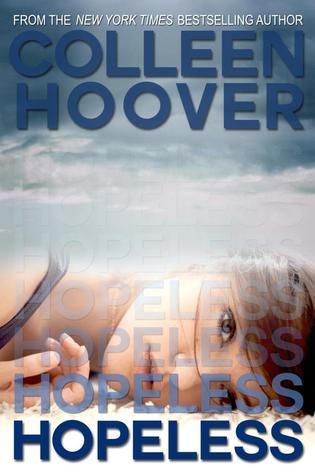 Sky, an intelligent, witty, and intense high-school girl,
seems to have a normal life until she meets Dean Holder, who changes her life
forever. The novel Hopeless by Colleen
Hoover was not what I expected, and a bit disappointing; however, it was very
interesting and a good read.
Sky, an intelligent, witty, and intense high-school girl,
seems to have a normal life until she meets Dean Holder, who changes her life
forever. The novel Hopeless by Colleen
Hoover was not what I expected, and a bit disappointing; however, it was very
interesting and a good read.
Colleen’s style of writing is magnificent; written in first
person, this storyline is beautiful. It’s a love story, which is my preference
because I’m a hopeless romantic. Sky falls in love with Dean, a mysterious and
even more intense guy.
Here’s the bad part. The
morals are corrupt. As a Christian, I believe Hopeless could have been just a little less hopeless without the
language, the sex, and the comments about "God". I'm not saying this
because I'm trying to preach, I'm saying this because the bad morals dumb down
the idea of true love and good decisions. So, to us Christians (and there are a
lot of us), those ideas aren't as perfect in the novel as some people (most
likely non-Christians) will see it.
Furthermore, although there is a different storyline that
can be interpreted from this book, I can’t neglect the fact that it almost
seems as if the sexual intercourse defined their relationship. Like, it was as
if they survived from that…eww. I really wasn’t looking for a sex novel, thank
you. If you’re into that kind of stuff, go for it! But me? Well, I admit I
should have read the reviews first, or just googled the book because when I do,
I find that the suggested novels include ones like 50 Shades of Grey! Ehh. . .red flags. All over the place.
I understand that a lot of people may disagree with me
because all of this is purely my opinion. If you like these kinds of books, are
looking for a romance novel that includes some action (of various sorts), then
read it. I can almost promise you that you’ll love it. However, I’d say that if
you’re like me and a Christian, and not looking for a sex novel, don’t read it.
Tuesday, January 28, 2014
CC 3.2 "Realistic" Children?
Media has everything from websites, to advertisements, to TV shows, to movies, to magazines, and much more. "Gender Issues In The Media", an article written by Shari Graydon and Elizabeth Verrall, talks about the negative impacts and influences that the media has on children and the way they develop.
 Messages from the media tend to be extremely stereotypical in the way they portray males and females, even when directed towards children. According to the text, "girls are shown as being endlessly preoccupied by their appearance, and fascinated primarily by dolls and jewellery." A girl's true personality and interests being disregarded, she may feel forced to act like the girls she sees on the media. If she doesn't want to, she might even feel like something is wrong with her because she can't meet the standards that the media sets for her, lowering her self-esteem.
 Also, the article states that "boys are encouraged to play sports and become engrossed by war play and technology." The same effect that was mentioned about girls can happen to boys. They are encouraged to be rough and rowdy; therefore, they are more likely to show aggressive behavior.
 Messages from the media tend to be extremely stereotypical in the way they portray males and females, even when directed towards children. According to the text, "girls are shown as being endlessly preoccupied by their appearance, and fascinated primarily by dolls and jewellery." A girl's true personality and interests being disregarded, she may feel forced to act like the girls she sees on the media. If she doesn't want to, she might even feel like something is wrong with her because she can't meet the standards that the media sets for her, lowering her self-esteem.
 Also, the article states that "boys are encouraged to play sports and become engrossed by war play and technology." The same effect that was mentioned about girls can happen to boys. They are encouraged to be rough and rowdy; therefore, they are more likely to show aggressive behavior.
However, children don't just see what is meant for children, they also are exposed to many adult things. The article states that children often watch/see media that is "intended for adult eyes only. These images also help shape the notions little girls and boys have about who they should be and what they can achieve". This has gotten so bad that I have even witnessed 5-year-old boys trying to look down women's shirts. Children are not supposed to even KNOW about anything sexual at that age. It's become so common now, it's like you can't find a PG movie without a sexual reference in it. Even Disney TV shows now!
On the bright side, children can be more influenced by positive things, and there are ways to minimize the effects of the stereotypical media on children. The text says, "Research tells us that the more television children watch, the more likely they are to demonstrate aggressive behaviour." So, just don't let them watch so much inappropriate media. After limiting what they watch, you can fill in the time gaps with more youthful and fulfilling, real-life events. Spend time with your children and educate them on the social media, showing them the differences between the stereotypes and reality as they grow.
In conclusion, no matter what the media wants to represent as a male and a female, you can set it straight. Children don't need to be exposed to something that will negatively alter their way of thinking. They will grow up too fast and not the way the way they should. If everyone grew up thinking they had to act like the characters on a "reality" show, what would the world even be like today?
In conclusion, no matter what the media wants to represent as a male and a female, you can set it straight. Children don't need to be exposed to something that will negatively alter their way of thinking. They will grow up too fast and not the way the way they should. If everyone grew up thinking they had to act like the characters on a "reality" show, what would the world even be like today?
Sunday, January 26, 2014
CC 3.1 For Everyone and Females
In an article called, "Ummmm, Wikipedia Removes Female Novelists from 'American Novelists' List," posted on Sparklife, Janet Manley focuses on an issue that made its appearance on Wikipedia, as Amanda Filipacchi, a novelist, watched the "American Novelist" page dwindle to males only, and a new page open which was entitled "Female American Novelists." However, I would say that Manley is overreacting just little bit.
Sometimes a person will have an idea that seems good at the time, and he or she later realizes that it wasn't such a great idea after all. First off, she states that "Wikipedia apparently set the wheels in reverse, putting
“American Women Novelists” back onto the main page." This means that the administrators recognized that they were at fault, and fixed the problem. Sure, we might wonder what was going through their heads when they decided to change it, but seeing that they changed their minds shows evidence that maybe their intent wasn't so bad after all. Maybe once they realized that there might be controversy, they reversed what they'd done.
Secondly, there is a difference between gender equality and everyone being exactly the same. Janet wants to know "how [women have] gotten this far in history without female cars or female books or hotdogs for women." I'd like to point out that there actually are female books. There are also men's books, but that's because there ARE differences between men and women. We think differently, have different physical advantages and disadvantages, and possess many other differences that studies have proven true. It's inevitable.
To clarify, I did not say that I completely disagree with Manley. There were two major problems with the situation. First of all, she states that "female authors from Haiti and other countries were also being bumped to subtopics on their respective pages." I can definitely see why people, specifically the novelists listed, would be upset about this. They'd think "Why am I less important now?" because they were moved to a subtopic page!

Also, I'll admit the way they chose to categorize things was pretty... dumb. The article says in parentheses that the women were not only separated from the men novelists (in subtopic pages), but the men were " not, Filpacchi notes, under 'Men Novelists'." Yeah, they were just Novelists. This should also cause an obvious problem because although we are not necessarily in the "Feminist Movement" anymore, our society is recently very passionate about gender equality. Not saying I am; not saying I'm not, but it is a big deal nowadays.
All in all, this article was pretty entertaining. Manley is a funny writer, her sense of humor outweighing the exhibited anger. However, maybe she could consider what she complains about, and whether it's really worth all the fuss. It's possible that she just wanted something to write about, and tried to amplify an issue to make it entertaining to her viewers. Who knows? All I know is my stance on the subject, and that is that this article is quite an overreaction. I would like to know though, how would you react if you were moved from main topic to subtopic?
Sometimes a person will have an idea that seems good at the time, and he or she later realizes that it wasn't such a great idea after all. First off, she states that "Wikipedia apparently set the wheels in reverse, putting
“American Women Novelists” back onto the main page." This means that the administrators recognized that they were at fault, and fixed the problem. Sure, we might wonder what was going through their heads when they decided to change it, but seeing that they changed their minds shows evidence that maybe their intent wasn't so bad after all. Maybe once they realized that there might be controversy, they reversed what they'd done.
Secondly, there is a difference between gender equality and everyone being exactly the same. Janet wants to know "how [women have] gotten this far in history without female cars or female books or hotdogs for women." I'd like to point out that there actually are female books. There are also men's books, but that's because there ARE differences between men and women. We think differently, have different physical advantages and disadvantages, and possess many other differences that studies have proven true. It's inevitable.
To clarify, I did not say that I completely disagree with Manley. There were two major problems with the situation. First of all, she states that "female authors from Haiti and other countries were also being bumped to subtopics on their respective pages." I can definitely see why people, specifically the novelists listed, would be upset about this. They'd think "Why am I less important now?" because they were moved to a subtopic page!

Also, I'll admit the way they chose to categorize things was pretty... dumb. The article says in parentheses that the women were not only separated from the men novelists (in subtopic pages), but the men were " not, Filpacchi notes, under 'Men Novelists'." Yeah, they were just Novelists. This should also cause an obvious problem because although we are not necessarily in the "Feminist Movement" anymore, our society is recently very passionate about gender equality. Not saying I am; not saying I'm not, but it is a big deal nowadays.
All in all, this article was pretty entertaining. Manley is a funny writer, her sense of humor outweighing the exhibited anger. However, maybe she could consider what she complains about, and whether it's really worth all the fuss. It's possible that she just wanted something to write about, and tried to amplify an issue to make it entertaining to her viewers. Who knows? All I know is my stance on the subject, and that is that this article is quite an overreaction. I would like to know though, how would you react if you were moved from main topic to subtopic?
Saturday, November 9, 2013
Current Connection 2.1 Choosing What to Say to the Child
In an article called "5 Things Parents Shouldn't Say To Their Kids", posted on Yahoo! Shine, Charlene Prince Birkeland, a Team Mom, addresses the issue that the choice of words parents use to communicate with their children directly impacts the parent-child relationship long term.
According to Birkeland, a commonly used ultimatum that is "sure to freak your child out [is] 'I'm going to leave without you!'" When I was told this as a child, I was scared at first, and I even had bad dreams about them leaving me behind. Even worse, I, a clever child, one who learns patterns at the snap of a finger, began catching on pretty quickly to the fact that they were not going to follow through; therefore, I did not always believe their threats.
Debora Gilboa, a parenting speaker, says, "If you want them to believe what we say is true, we cannot say something that is patently false." My parents may have made this mistake with me, but my sister Danielle is only 5, and I can warn them about this. It may be the reason that I sometimes don't even believe their threats now, like taking my phone for example.
 Although the intent behind a parents' words are usually honorable, sometimes they still need to be careful about making their intent clear. Birkeland, supporting this point, also states that the command, "Say you're
sorry!", can cause a "delay [of] the child's natural acceptance". Have you ever met a person who constantly apologizes out of
habit? Luckily, I am not too bad about it, but I have met a few motorboats who splash out their apologies left and right every time they hit the water. They spew and murmur until they are completely shut off.
Although the intent behind a parents' words are usually honorable, sometimes they still need to be careful about making their intent clear. Birkeland, supporting this point, also states that the command, "Say you're
sorry!", can cause a "delay [of] the child's natural acceptance". Have you ever met a person who constantly apologizes out of
habit? Luckily, I am not too bad about it, but I have met a few motorboats who splash out their apologies left and right every time they hit the water. They spew and murmur until they are completely shut off.Birkeland makes the point that "Young children don't automatically understand why they have to apologize." If one goes through their childhood apologizing and not even knowing what for, he/she will do that all their life, mindlessly blaming oneself about every little thing. Fortunately, my parents made sure I was specific about what I was apologizing for, and that could be the reason I am not that annoying "apologizer" now.
Deciding what to say, thinking before one speaks, and choosing how to deliver a message to a child should not be taken lightly. Instead, try to develop a habit of deciding one's words before saying them, and considering how those words might impact the child later on. Furthermore, there is always an opportunity for correction, so do not fret too much if an unwanted word or phrase slips out.
Thursday, October 17, 2013
Current Connection 1.2 Fighting For Education
While students in America complain about school and skip
school because they just “don’t feel like going”, and they talk about how much
they hate school, students in countries like Pakistan, Nigeria, and many others,
are fighting with their lives to have an education like America’s.
Diya Nijhowne, director of the Global Coalition to Protect Education from Attack, states in her article, "The right to education is under seige", that “The Taliban, for instance, demolish schools and threaten teachers and students where they believe the education provided is ‘un-Islamic’.”, and “a principal and six school children died [in March] during an attack at their school in Karachi”. These are only a couple examples of the many problems students face outside of this spoiled, comfortable little niche called America. Instead of taking American education for granted, students should appreciate what they have here in honor of those who do not have this. Not convinced yet?
Nijhowne also claims that “[they] have documented attacks on education in about 30 countries in the last five years”. After knowing this, surely deep down some students are thinking “What is so wrong with education anyway?” or “Why would people go to such extremes to stop education?”. This thought occurs because truly, American education isn’t actually all that bad!
If fellow students in other countries are fighting for their right to an education, American students should rethink fighting to not go to school.
Website: CNN.com
Diya Nijhowne, director of the Global Coalition to Protect Education from Attack, states in her article, "The right to education is under seige", that “The Taliban, for instance, demolish schools and threaten teachers and students where they believe the education provided is ‘un-Islamic’.”, and “a principal and six school children died [in March] during an attack at their school in Karachi”. These are only a couple examples of the many problems students face outside of this spoiled, comfortable little niche called America. Instead of taking American education for granted, students should appreciate what they have here in honor of those who do not have this. Not convinced yet?
Nijhowne also claims that “[they] have documented attacks on education in about 30 countries in the last five years”. After knowing this, surely deep down some students are thinking “What is so wrong with education anyway?” or “Why would people go to such extremes to stop education?”. This thought occurs because truly, American education isn’t actually all that bad!
Also stated in the article, “violence and threats against
education stunt long term social development and economic growth for the whole
community”. Imagine never having had an education, the only way we can learn
how to think.What would America look like? People see others as ignorant now,
just think what it would be like if no one knew anything.
A persecuted female student named Malala says that “They thought that the bullets would silence us. But they failed. And then, out of that silence came thousands of voices.” Those voices shouldn’t be just theirs; American students should stand up for those students as well. Not only should they defend them, but they should appreciate the abundance of freedom they have to an education, and to think.
A persecuted female student named Malala says that “They thought that the bullets would silence us. But they failed. And then, out of that silence came thousands of voices.” Those voices shouldn’t be just theirs; American students should stand up for those students as well. Not only should they defend them, but they should appreciate the abundance of freedom they have to an education, and to think.
If fellow students in other countries are fighting for their right to an education, American students should rethink fighting to not go to school.
Website: CNN.com
Subscribe to:
Comments (Atom)